
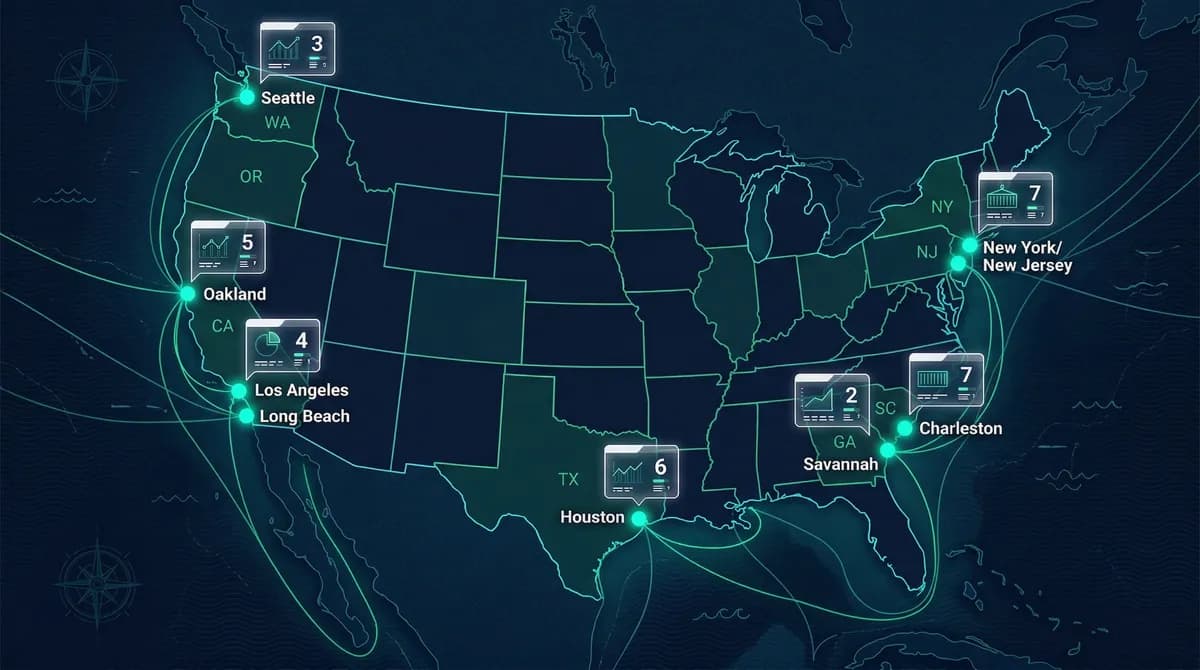
Key Takeaways
- ✓US port free days vary from 3–7 days depending on the terminal, carrier, and container type — reefer containers consistently receive 1–2 fewer days than dry
- ✓Terminal free days and carrier free days are calculated independently; the earliest expiring clock determines when your charges begin
- ✓Demurrage start rates at major US ports range from $60/day (smaller Gulf/Atlantic ports) to $250/day (NY/NJ and LA/LB), escalating in tiers
- ✓Weekends and US federal holidays count toward free days at most carriers, but CMA CGM and Hapag-Lloyd exclude them at select terminals — always verify your specific tariff
- ✓High-volume importers regularly negotiate 7–10 free days via service contracts, reducing average demurrage exposure by 40–60% compared to standard tariff terms
US Port Free Days: What You Need Before Booking Drayage
Understanding US port free days is the first step to controlling demurrage costs on import containers. Free day allowances — the window you have to pick up a container before daily charges begin — differ by port, terminal operator, ocean carrier, container type, and contract terms. Consolidating that data into a single view is the only way to plan drayage without guesswork.
This guide covers every major US port and the terminals within each, with the free day allowances and demurrage start rates you need for planning. Use it alongside your carrier's specific tariff — rates shown reflect published tariffs as of Q1 2026 and should be verified before committing to pickup schedules.
For a deeper dive on how the two free day systems interact, see the full LFD tracking guide. For terminal-level breakdowns at the two largest West Coast ports, see Port of LA free days and Port of Long Beach free days.
Master US Port Free Days Comparison Table
The table below covers carrier-granted import free days (line demurrage) and terminal storage free days for dry and reefer containers at each major US port terminal. Demurrage start rates reflect Tier 1 (first days over LFD) from each carrier's published D&D tariff. Terminal storage rates are set by the terminal operator, not the SSL.
| Port | Terminal | Primary Carriers | Type | Import Free Days | Demurrage Tier 1 Rate | Source / Updated |
|---|---|---|---|---|---|---|
| Los Angeles | APM Terminals (APMT LA) | Maersk, MSC | Dry | 4–5 days | $75–$150/day (terminal storage) | APMT / Jan 2026 |
| Los Angeles | APM Terminals (APMT LA) | Maersk, MSC | Reefer | 2–3 days | $150–$250/day (terminal storage) | APMT / Jan 2026 |
| Los Angeles | Fenix Marine Services (FMS) | CMA CGM, Evergreen | Dry | 4 days | $75–$150/day (terminal storage) | FMS tariff / Jan 2026 |
| Los Angeles | Fenix Marine Services (FMS) | CMA CGM, Evergreen | Reefer | 2 days | $175–$250/day (terminal storage) | FMS tariff / Jan 2026 |
| Los Angeles | TraPac Terminal (LA) | ONE, Hapag-Lloyd | Dry | 5 days | $75–$150/day (terminal storage) | TraPac tariff / Jan 2026 |
| Los Angeles | West Basin Container Terminal (WBCT) | COSCO, ZIM | Dry | 4 days | $75–$150/day (terminal storage) | WBCT tariff / Jan 2026 |
| Long Beach | Long Beach Container Terminal (LBCT) | MSC | Dry | 5 days | $75–$198/day (terminal storage) | LBCT tariff / Jan 2026 |
| Long Beach | Long Beach Container Terminal (LBCT) | MSC | Reefer | 3 days | $200–$300/day (terminal storage) | LBCT tariff / Jan 2026 |
| Long Beach | SSA Marine / Total Terminals (TTI) | Hapag-Lloyd | Dry | 5 days | $75–$175/day (terminal storage) | TTI tariff / Jan 2026 |
| Long Beach | International Transportation Services (ITS) | Evergreen, COSCO | Dry | 4–5 days | $75–$150/day (terminal storage) | ITS tariff / Jan 2026 |
| Long Beach | Pacific Container Terminal (PCT) | ONE, ZIM | Dry | 4 days | $75–$150/day (terminal storage) | PCT tariff / Jan 2026 |
| Oakland | TraPac Oakland | ONE, Hapag-Lloyd | Dry | 4 days | $75–$150/day (terminal storage) | TraPac tariff / Jan 2026 |
| Oakland | SSA Oakland (Outer Harbor) | MSC, ZIM | Dry | 4 days | $75–$125/day (terminal storage) | SSA tariff / Jan 2026 |
| Oakland | Everport Terminal Services | Evergreen, COSCO | Dry | 4 days | $75–$125/day (terminal storage) | Everport tariff / Jan 2026 |
| Oakland | TraPac Oakland | ONE, Hapag-Lloyd | Reefer | 3 days | $150–$200/day (terminal storage) | TraPac tariff / Jan 2026 |
| Seattle / Tacoma | Terminal 18 (T-18, SSA) | MSC, CMA CGM | Dry | 4–5 days | $75–$175/day (terminal storage) | T-18 tariff / Jan 2026 |
| Seattle / Tacoma | Terminal 30 (T-30, SSA) | Maersk, ZIM | Dry | 4 days | $75–$150/day (terminal storage) | T-30 tariff / Jan 2026 |
| Seattle / Tacoma | Husky Terminal (T-46) | Evergreen, ONE | Dry | 5 days | $75–$150/day (terminal storage) | Husky tariff / Jan 2026 |
| Seattle / Tacoma | Washington United Terminals (WUT) | Hapag-Lloyd, COSCO | Dry | 4–5 days | $75–$150/day (terminal storage) | WUT tariff / Jan 2026 |
| Seattle / Tacoma | Terminal 18 (T-18, SSA) | MSC, CMA CGM | Reefer | 3 days | $175–$250/day (terminal storage) | T-18 tariff / Jan 2026 |
| New York / New Jersey | APM Terminals (Port Newark) | Maersk | Dry | 5 days | $100–$250/day (terminal storage) | APMT / Jan 2026 |
| New York / New Jersey | Maher Terminals | MSC, CMA CGM | Dry | 4–5 days | $100–$225/day (terminal storage) | Maher tariff / Jan 2026 |
| New York / New Jersey | Port Newark Container Terminal (PNCT) | Hapag-Lloyd, ONE | Dry | 5 days | $100–$225/day (terminal storage) | PNCT tariff / Jan 2026 |
| New York / New Jersey | GCT Bayonne (Global Container Terminals) | COSCO, Evergreen, ZIM | Dry | 4 days | $100–$200/day (terminal storage) | GCT tariff / Jan 2026 |
| New York / New Jersey | Maher Terminals | MSC, CMA CGM | Reefer | 2–4 days | $200–$350/day (terminal storage) | Maher tariff / Jan 2026 |
| Savannah | Garden City Terminal (GPA) | Maersk, MSC, CMA CGM, Hapag-Lloyd, ONE, ZIM, Evergreen, COSCO | Dry | 4 days | $75–$150/day (terminal storage) | GPA tariff / Jan 2026 |
| Savannah | Garden City Terminal (GPA) | All major SSLs | Reefer | 3 days | $175–$250/day (terminal storage) | GPA tariff / Jan 2026 |
| Savannah | Ocean Terminal (GPA) | Selective SSL services | Dry | 4 days | $75–$125/day (terminal storage) | GPA tariff / Jan 2026 |
| Charleston | Wando Welch Terminal (SCSPA) | Maersk, CMA CGM, Hapag-Lloyd, ONE, Evergreen | Dry | 5 days | $75–$125/day (terminal storage) | SCSPA tariff / Jan 2026 |
| Charleston | Hugh K. Leatherman Terminal (SCSPA) | MSC, COSCO, ZIM | Dry | 5 days | $75–$125/day (terminal storage) | SCSPA tariff / Jan 2026 |
| Charleston | Wando Welch Terminal (SCSPA) | Maersk, CMA CGM, Hapag-Lloyd | Reefer | 3 days | $150–$225/day (terminal storage) | SCSPA tariff / Jan 2026 |
| Houston | Bayport Container Terminal (Port Houston) | MSC, CMA CGM, ONE, Hapag-Lloyd | Dry | 4–5 days | $60–$150/day (terminal storage) | Port Houston tariff / Jan 2026 |
| Houston | Barbours Cut Terminal (Port Houston) | Maersk, COSCO, ZIM, Evergreen | Dry | 4 days | $60–$125/day (terminal storage) | Port Houston tariff / Jan 2026 |
| Houston | Bayport Container Terminal (Port Houston) | MSC, CMA CGM | Reefer | 3 days | $150–$225/day (terminal storage) | Port Houston tariff / Jan 2026 |
| Miami | Port of Miami Terminal (POMTOC) | MSC, CMA CGM, Evergreen | Dry | 5 days | $60–$125/day (terminal storage) | PortMiami tariff / Jan 2026 |
| Miami | South Florida Container Terminal (SFCT) | Maersk, Hapag-Lloyd, ZIM | Dry | 5 days | $60–$125/day (terminal storage) | SFCT tariff / Jan 2026 |
| Miami | Port of Miami Terminal (POMTOC) | MSC, CMA CGM | Reefer | 3 days | $125–$225/day (terminal storage) | PortMiami tariff / Jan 2026 |
| Norfolk | Norfolk International Terminals (VPA) | Maersk, MSC, CMA CGM, Hapag-Lloyd | Dry | 5 days | $60–$120/day (terminal storage) | VPA tariff / Jan 2026 |
| Norfolk | Virginia International Gateway (VIG) | ONE, Evergreen, COSCO, ZIM | Dry | 5 days | $60–$120/day (terminal storage) | VPA tariff / Jan 2026 |
| Norfolk | Norfolk International Terminals (VPA) | Maersk, MSC | Reefer | 3 days | $125–$200/day (terminal storage) | VPA tariff / Jan 2026 |
Terminal storage rates shown are independent of carrier demurrage. Both charges can accrue simultaneously on the same container. Carrier demurrage rates vary by SSL — see the carrier free days comparison for SSL-specific tiered rates. All data reflects Q1 2026 published tariffs.
How Carrier Free Days Layer On Top of Terminal Free Days
The comparison table above shows terminal storage free days — the time the terminal operator grants before its storage fee kicks in. Carrier (line) demurrage is a separate charge governed by the ocean carrier's own tariff. Both clocks run independently.
A container moving through APM Terminals Los Angeles on Maersk has two separate free day windows: Maersk's 4 carrier free days (per Maersk's January 2026 D&D tariff update) and APM's 4–5 terminal storage free days. If the carrier LFD falls on Day 4 and the terminal LFD falls on Day 5, picking up on Day 4 avoids carrier demurrage but not terminal storage on that last day.
The practical consequence: track both dates for every container, not just the one that appears in the carrier's portal. Carrier portals typically show only line LFD. Terminal storage LFD requires a separate lookup on the terminal's website or via EDI.
Standard Carrier Free Day Allowances at Major US Ports
| Carrier | Dry Import Free Days | Reefer Import Free Days | Demurrage Day 1–4 Rate | Demurrage Day 5–8 Rate | Demurrage Day 9+ Rate |
|---|---|---|---|---|---|
| Maersk | 4 days | 2 days | $225/day | $350/day | $450/day |
| MSC | 5 days | 3 days | $200/day | $325/day | $425/day |
| CMA CGM | 4 days | 2 days | $250/day | $375/day | $475/day |
| Hapag-Lloyd | 5 days | 3 days | $200/day | $300/day | $400/day |
| ONE (Ocean Network Express) | 5 days | 3 days | $195/day | $295/day | $395/day |
| ZIM | 4 days | 2 days | $225/day | $350/day | $425/day |
| Evergreen | 5 days | 3 days | $190/day | $290/day | $390/day |
| COSCO | 5 days | 3 days | $185/day | $285/day | $385/day |
Rates per each carrier's published D&D tariff as of Q1 2026 (e.g., per Maersk's January 2026 D&D tariff update, MSC's February 2026 tariff circular, CMA CGM's January 2026 D&D schedule). Contract rates negotiated via service agreement may differ substantially. For full carrier-by-carrier analysis, see the carrier free days comparison guide.
How Container Type Affects Free Days
Reefer (refrigerated) containers consistently receive fewer free days than equivalent dry containers — typically 1–2 days less at both the carrier and terminal level. The reason is operational: reefers require active shore power connections at the terminal, and each additional day of storage represents a real cost to the terminal operator for electricity and monitoring labor.
At Port of Long Beach's LBCT, a dry container gets 5 free days; a reefer gets 3. At APM Terminals Los Angeles, a dry container gets 4–5 days; a reefer gets 2–3. This pattern is consistent across nearly every major US terminal. Reefer demurrage rates also run higher — terminal storage rates for reefers often exceed dry rates by $75–$150/day from the first day over LFD.
Flat-rack and open-top containers (OOG — out of gauge cargo) may have separate tariff schedules. If you're moving project cargo or oversized freight, verify free day terms directly with the terminal operator before the vessel arrives.
How Weekends and Holidays Affect Free Day Calculations
The calendar-vs-business-day question is one of the most common sources of missed LFDs. Different carriers handle this differently, and the impact can be significant — a 4-day window that excludes weekends is a 4-business-day window, extending from a Monday discharge through the following Thursday rather than the following Friday.
Carrier Weekend and Holiday Policies
| Carrier | Weekend Days | US Federal Holidays | Notes |
|---|---|---|---|
| Maersk | Count toward free days | Count toward free days | Calendar days throughout; per Jan 2026 tariff |
| MSC | Count toward free days | Count toward free days | Calendar days; per Feb 2026 tariff circular |
| CMA CGM | Excluded at select ports | Excluded | Verify per port — not uniform across US |
| Hapag-Lloyd | Count toward free days | Excluded at most US terminals | Holiday exclusion applies to LFD extension, not free time calculation |
| ONE | Count toward free days | Count toward free days | Calendar days; contract terms may vary |
| ZIM | Count toward free days | Count toward free days | Calendar days throughout |
| Evergreen | Count toward free days | Count toward free days | Calendar days; verify local tariff addenda |
| COSCO | Count toward free days | Count toward free days | Calendar days throughout |
The practical rule: assume calendar days unless your carrier's specific tariff says otherwise. If a Friday discharge gives you 4 days, your LFD is Tuesday — the terminal may be fully operational Saturday and Sunday, but demurrage starts Wednesday regardless of whether the terminal is open. Plan drayage pickup for Friday or Saturday to avoid weekend risk.
Terminal Gate Schedules and LFD
LFD expiration and terminal gate hours are two separate issues. A container's LFD may be a Saturday, but if the terminal runs Saturday gate hours, you can still pick it up on time. If the terminal is closed Saturday and your LFD falls on Saturday, most carriers will recognize Monday as the effective pickup deadline — but this is not automatic. You must confirm the terminal's operating schedule and, if necessary, request an LFD extension in advance.
Port of Savannah's Garden City Terminal operates extended weekday and Saturday gate hours during peak season (typically August through November). Many West Coast terminals at the Ports of LA and Long Beach run Saturday gates year-round but are closed Sundays. Verify gate schedules at Port of LA terminal directory or Port of Long Beach terminal list.
Port-by-Port Notes for Logistics Planners
Los Angeles / Long Beach
The San Pedro Bay port complex processes roughly 40% of all US import containers, making it the highest-stakes environment for free day management. Terminal storage rates here are among the highest in the country — Maher-comparable rates at LBCT can reach $198/day in the upper tier. The LA/LB complex also has the most terminal operators with distinct tariff schedules, meaning the same carrier may offer different effective free day windows depending on which terminal their vessel calls.
For full terminal-by-terminal analysis, see the dedicated Port of LA free days guide and Port of Long Beach free days guide.
New York / New Jersey
NY/NJ has the highest terminal storage rates of any US port, with upper-tier storage at Maher Terminals exceeding $250/day for dry containers. Four major terminal operators serve the port complex — APM, Maher, PNCT, and GCT Bayonne — each with independent storage tariffs. Free day allowances at NY/NJ terminals tend to run slightly longer (4–5 days) than comparable West Coast terminals to offset the higher per-day rates.
Savannah
The Georgia Ports Authority operates a consolidated terminal model — Garden City Terminal handles the vast majority of container traffic, simplifying the free day picture compared to multi-terminal ports. GPA's 4-day standard is consistent across carriers. The port's inland rail connections make rail LFD tracking important here — containers moving via Norfolk Southern or CSX to inland destinations have a separate rail storage clock that starts the moment they arrive at the inland ramp.
Charleston
The South Carolina Ports Authority administers both Wando Welch and the newer Hugh K. Leatherman Terminal under a unified tariff, making free day terms consistent across the port. Charleston's 5-day standard free days are among the more generous in the US — a meaningful advantage for importers who frequently need extra time for customs clearance or inland transport coordination.
Houston
Port Houston operates Bayport and Barbours Cut under separate terminal tariffs despite both being authority-operated facilities. Bayport, as the newer facility, handles larger vessels and carries slightly higher storage rates. Houston's proximity to petrochemical and industrial customers means a high proportion of containerized imports move quickly — but reefer cargo, particularly food-grade and pharmaceutical shipments, benefits from the port's cold chain infrastructure and must be prioritized given the shorter free day windows.
Norfolk
Virginia Port Authority's dual-terminal structure (NIT and VIG) offers 5 free days at both facilities — the same generous standard as Charleston. Norfolk is the largest port on the mid-Atlantic coast and serves as a primary gateway for military cargo, agricultural exports, and Midwest-bound imports moving via rail. The VIG terminal's on-dock rail connection means intermodal LFD tracking is especially relevant at this port.
Negotiating Better Free Day Terms
Published tariff free days are the floor, not the ceiling. High-volume importers — typically those moving 200+ TEU per month with a given carrier — regularly negotiate service contract terms that extend free time to 7, 10, or even 14 days. A single extra day of free time per container, multiplied across 200 monthly shipments, eliminates roughly $40,000 in annual demurrage exposure at a $200/day first-tier rate.
The leverage points for negotiation are volume commitment, cargo mix (carriers value dry cargo and avoid over-concentrating reefer), port diversity (offering volume at less-congested terminals), and contract length. A 2-year volume commitment at a named port typically generates better free day terms than spot bookings.
Terminal storage free days are harder to negotiate directly — terminal operators rarely extend storage terms for individual importers. The exception is large distribution center operators with direct terminal relationships, who sometimes secure special facility arrangements that include extended dwell allowances.
Data Sources and Verification
Free day schedules and demurrage rates change. Carriers typically issue tariff updates quarterly, with ad hoc adjustments during peak periods. The following are the authoritative sources for verifying current terms before your cargo moves:
Carrier D&D Tariff Pages
- Maersk: Maersk.com → Support → Demurrage & Detention Tariff (updated January 2026)
- MSC: MSC.com → Tools → Tariffs → Local Charges (updated February 2026)
- CMA CGM: CMA-CGM.com → Tools → Local Charges by Port (updated January 2026)
- Hapag-Lloyd: Hapag-Lloyd.com → Online Business → Tariffs → Demurrage & Detention (updated January 2026)
- ONE: One-line.com → Tools → Tariff → D&D Rates (updated Q4 2025)
- ZIM: ZIM.com → Customer Center → Tariffs (updated January 2026)
- Evergreen: Evergreen-line.com → Customer Service → Tariff Enquiry (updated January 2026)
- COSCO: Cosco-usa.com → Tools → Tariff (updated Q4 2025)
Regulatory and Port Authority Sources
- FMC Demurrage & Detention — Federal Maritime Commission: The authoritative regulatory source for D&D billing rules, 46 CFR Part 545, and the FMC's interpretive rule on the Shipping Act's demurrage provisions.
- Port of Los Angeles: Terminal directory, gate schedules, and tariff schedules for all LA marine terminals.
- Georgia Ports Authority (GPA): GAPorts.com publishes current terminal tariff schedules for Garden City and Ocean Terminal, including storage free day tables updated quarterly.
- Virginia Port Authority (VPA): VaPort.com publishes current terminal tariffs for NIT and VIG, including storage rate schedules.
The FMC's demurrage and detention resources also include guidance on disputing invoices that violate 46 CFR Part 545's billing transparency requirements — a useful reference when a carrier issues an invoice covering a period when the container was on a customs hold or government examination.
Tracking Free Days Across Multiple Ports and Carriers
A freight forwarder managing 150 active containers across six ports and five carriers is looking at potentially 15–20 distinct terminal tariff schedules and eight carrier D&D tariffs, all with different free day windows, rate tiers, and weekend policies. Manually reconciling that data daily — then cross-referencing against vessel discharge dates, availability notifications, customs clearance status, and drayage appointment slots — is operationally untenable.
The only approach that scales is API-based LFD aggregation: a system that pulls discharge dates, availability status, and LFD data from carrier APIs and terminal EDI feeds, consolidates into a single dashboard sorted by LFD urgency, and sends automated alerts at 72-hour, 48-hour, and 24-hour thresholds. See the full LFD tracking guide for how this works operationally and what to look for in an API-based tracking solution.
For understanding how carrier-specific free day policies interact with port-level terminal schedules, the carrier free days comparison provides the carrier-by-carrier matrix that complements the port-focused data above.