
Key Takeaways
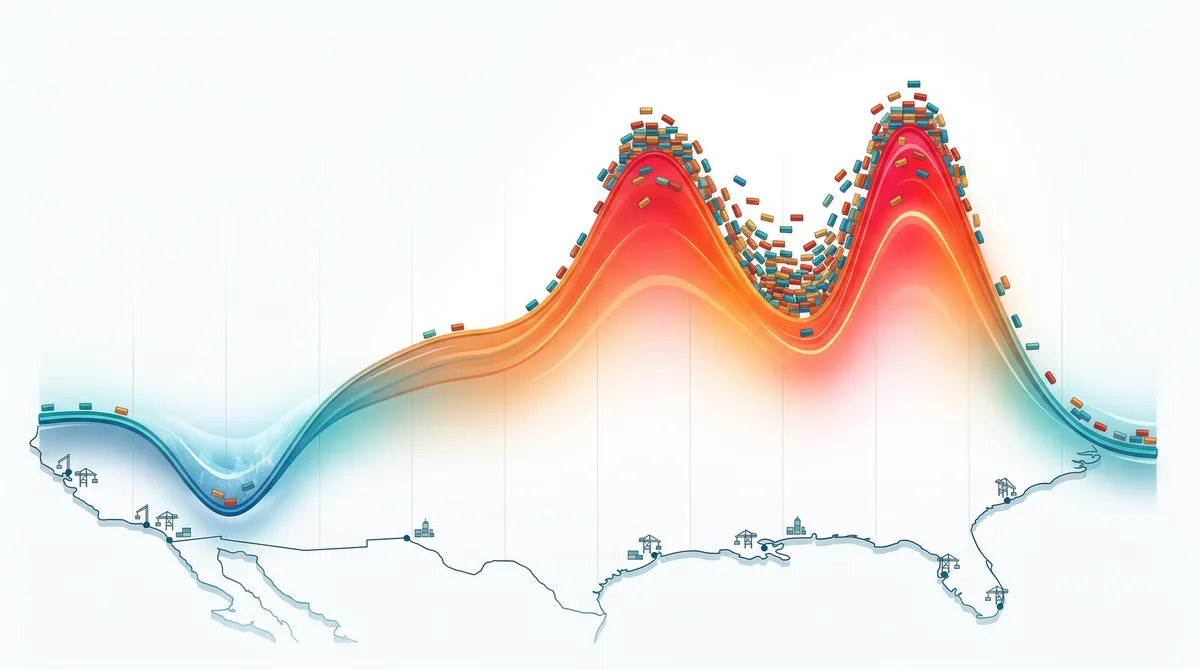
- ✓Seasonal demurrage at US ports peaks from September through November — the pre-holiday import surge routinely doubles terminal dwell times at LA/LB and Savannah
- ✓Chinese New Year (January–February) creates an inventory rebound effect: factories reopen in March and flood US ports with back-to-back vessel arrivals through April
- ✓Carriers including Maersk, MSC, and CMA CGM routinely impose peak season surcharges that reduce contractual free time by 1–2 days during Q3–Q4
- ✓Port of NY/NJ experiences a secondary congestion spike in May–June driven by seasonal retail imports that West Coast ports do not see at the same intensity
- ✓Automated LFD tracking is most critical during August–November when vessel bunching, chassis shortages, and gate appointment backlogs can compress effective free time to fewer than 48 hours
Why Seasonal Demurrage at US Ports Follows a Predictable Cycle
Seasonal demurrage at US ports is not random. It tracks the global retail calendar — specifically the ordering cycles of American big-box retailers, which drive roughly 60% of transpacific container volume. When retailers place orders in May and June for back-to-school and holiday inventory, the resulting vessel arrivals hit US ports in August through October. Terminals that were operating comfortably at 70% capacity in the spring suddenly absorb 95%+ utilization in the fall.
Congestion compounds the problem. When berths are backed up, vessels anchor offshore for days. When vessels finally discharge, containers flood onto the terminal simultaneously. Chassis pools deplete. Gate appointment systems get overwhelmed. Drayage capacity that was adequate in April cannot clear the volume in September. The result: containers that should have been picked up in 3 days sit for 7, and demurrage charges mount.
Understanding when these cycles hit — and at which ports — gives freight forwarders the lead time to negotiate free time extensions, pre-position drayage capacity, and prioritize LFD tracking resources before congestion peaks.
Month-by-Month Demurrage Risk by US Port
The table below reflects historical congestion patterns based on Port of LA throughput data and Georgia Ports Authority statistics. Risk levels indicate the probability that vessel bunching, terminal congestion, or chassis shortages will push effective pickup windows past standard free time.
| Month | LA / Long Beach | Port of Savannah | Port of NY/NJ | Port of Houston | Primary Driver |
|---|---|---|---|---|---|
| January | Low | Low | Low | Low | Post-holiday volume drop |
| February | Low | Low | Low | Low | Chinese New Year factory shutdowns |
| March | Medium | Low | Medium | Low | CNY rebound orders hitting water |
| April | Medium | Medium | Medium | Low | Spring import surge begins |
| May | Medium | Medium | High | Medium | East Coast retail season early arrivals |
| June | Medium | Medium | High | Medium | Back-to-school inventory movement starts |
| July | High | High | High | Medium | Pre-peak season surge; vessel bunching |
| August | High | High | High | High | Peak season arrival wave; chassis strain |
| September | Critical | Critical | Critical | High | Holiday import peak; terminal saturation |
| October | Critical | Critical | Critical | High | Holiday inventory final push; gate backlogs |
| November | High | High | High | Medium | Volume tapering but terminals still strained |
| December | Medium | Medium | Medium | Low | Holiday shutdowns reduce terminal labor |
Peak Season Deep Dive: July Through November
The July–November window is when demurrage charges inflict the most damage on import operations. The mechanics are straightforward: retailers typically place orders for holiday merchandise in April and May, with factory production in China and Vietnam completing in June and July. Vessels are loaded at ports like Yantian, Ningbo, and Kaohsiung in July, arriving at US West Coast ports in late July through September after a 12–14 day transpacific transit.
What makes this period operationally brutal is the compounding effect of simultaneous constraints. Terminals are running at or above designed capacity. The Alameda Corridor into the inland empire sees rail congestion. Chassis pools — already thin at baseline — cannot absorb the incremental demand. Gate appointment slots at APM Terminals, Fenix Marine, and LBCT at the Port of Long Beach book out 3–5 days in advance. A container with a 4-day free time allowance effectively has 1–2 days of pickup window after appointment systems are factored in.
Carriers are fully aware of this dynamic. Maersk, MSC, CMA CGM, Hapag-Lloyd, ONE, and ZIM all historically issue peak season surcharge notices that take effect between July 1 and August 15, adding $500–$1,000 per TEU in additional fees. Some of these surcharges reduce complimentary free time from standard tariff levels, meaning your LFD arrives sooner than your contract suggested.
Chinese New Year: The Deceptive Quiet Before March
January and February are statistically the lowest-risk months for demurrage across all major US ports. Factories in China shut down for two to three weeks around Chinese New Year (typically late January or early February), which dramatically reduces export bookings. US terminals clear their backlogs. Free time extensions are easy to obtain. Drayage capacity is abundant.
The danger is what happens next. Factories reopen in mid-to-late February and immediately process the backlog of orders that accumulated during the holiday. The result is a compressed burst of production — often 4–6 weeks of output shipped within a 2–3 week window. These containers arrive at US ports in late March and April, creating a predictable mini-congestion event that catches forwarders who relaxed their LFD discipline during the quiet period.
Operationally, treat the Chinese New Year lull as an opportunity to reset your LFD tracking systems and negotiate free time adjustments, not as permission to reduce monitoring frequency. The rebound arrives fast.
Port-Specific Seasonal Patterns
Port of LA and Port of Long Beach
The San Pedro Bay complex — handling roughly 40% of US containerized imports — shows the most extreme seasonal demurrage swings in the country. During the 2021 and 2022 congestion crises, vessels waited an average of 17 days at anchor before berth assignment. While that extreme has eased, the underlying capacity constraints remain. September and October at LA/LB regularly see terminal dwell times of 5–7 days for import containers, against a standard 4-day free time allowance. For detailed free time terms at each terminal, see our US port free days comparison.
The seasonal congestion at LA/LB is amplified by labor dynamics. The ILWU contract — covering dock workers across all West Coast ports — has historically produced work slowdowns during peak season negotiations. The 2022–2023 contract negotiations produced measurable throughput reductions from May through October 2023. Forwarders with heavy West Coast exposure should monitor labor developments each year as an early warning indicator.
Port of NY/NJ
NY/NJ operates on a different seasonal curve than the West Coast ports. The port sees two distinct congestion windows: a spring surge in May–June driven by East Coast retail imports (furniture, home goods, apparel) and the standard fall peak in September–October shared by all ports. The spring window is unique to the East Coast because many importers deliberately shifted cargo post-2021 to avoid West Coast labor uncertainty, increasing East Coast baseline volume by 15–20%.
Container availability at NY/NJ is also complicated by the Bayonne Bridge clearance requirement, which affects vessel calls at GCT Bayonne. Larger vessels with higher container volumes call fewer times but discharge more containers per call, creating sharper congestion spikes at APM and Maher terminals when a large vessel discharges during an already-busy period.
Port of Savannah
The Port of Savannah — now the third-largest container port in the US — has absorbed significant volume growth since 2020 as importers diversified away from LA/LB. The Georgia Ports Authority's Garden City Terminal is the single largest single-terminal container facility in the Western Hemisphere by acreage, but volume growth has tested its capacity in September and October.
Savannah's unique congestion pattern involves inland container transfer facilities (ICTFs). The GPA operates a network of inland ports across Georgia, South Carolina, and Tennessee. When Savannah's terminal gets congested, drayage to these inland facilities becomes an overflow valve — but it also means containers move to rail before customs clearance is complete, creating rail LFD exposure that many importers don't anticipate. Understanding all three LFD types is especially important at Savannah. See our complete LFD tracking guide for how line LFD, terminal LFD, and rail LFD interact.
How Carriers Adjust D&D Rates Seasonally
Peak season surcharges are the most visible seasonal adjustment, but carriers make subtler changes that directly affect demurrage exposure. Maersk and CMA CGM have both issued peak season tariff amendments that temporarily reduce free time for import containers arriving at congested ports — from 4 calendar days to 3 at specific terminals during August–October. These amendments are buried in tariff circulars that most operational staff never see.
MSC has used a different mechanism: maintaining stated free days but issuing equipment redelivery requirements that effectively compress pickup windows. Hapag-Lloyd introduced peak season chassis fees during the 2022 and 2023 peak seasons, adding $75–$150 per container to inland drayage costs. ONE and ZIM have been more consistent with standard terms during peak season but have introduced port congestion surcharges that add to total landed cost without affecting free time directly.
The practical implication: review carrier tariff amendments proactively each July for changes effective August through October. Filing a tariff review task in early July costs nothing. Missing a free time reduction on 50 containers in September could cost $15,000–$30,000 in unexpected charges.
Pre-Peak Season Planning Checklist for Freight Forwarders
Run this checklist each June before the August–November peak season:
- Audit current carrier tariffs — Download current D&D tariff pages for Maersk, MSC, CMA CGM, Hapag-Lloyd, ONE, and ZIM. Note current free day allowances per port per container type.
- Set a tariff amendment calendar alert — Watch for new tariff circulars from all carriers in July. Amendments effective August 1 are the most common peak season change date.
- Pre-qualify drayage carriers for peak season capacity — Confirm truck availability and gate appointment capabilities at your top 3–5 terminals before August. Lock in rates and capacity commitments in writing.
- Negotiate free time extensions proactively — Contact carrier account managers in June or July to request extended free time on peak season shipments before congestion begins. Extensions are easier to grant before a crisis than during one.
- Review chassis pool memberships — Confirm your drayage partners have access to chassis pools at LA/LB (DCLI, TRAC, Flexi-Van), Savannah (DCLI), and NY/NJ (TRAC). Chassis shortages during peak season are the most common cause of avoidable demurrage.
- Set LFD alert thresholds earlier — During non-peak months, a 48-hour LFD alert may be sufficient. Adjust alert thresholds to 72–96 hours during August–November to account for gate appointment lead times.
- Identify FMC complaint procedures — The FMC's Industry Assistance & Ombudsman office handles demurrage disputes when containers are inaccessible due to terminal or carrier actions. Know the process before you need it.
How Automated LFD Tracking Helps During Congestion Surges
During peak season, the manual LFD tracking process breaks down at exactly the wrong moment. A freight forwarder managing 150 active containers needs to check 6–8 carrier portals, 10–15 terminal websites, and multiple rail portals every day. During congestion surges, LFDs change — carriers update vessel discharge dates, terminals revise availability status, and chassis shortages cause containers to miss pickup windows that triggered last-minute extension requests. Manual tracking cannot keep pace.
Automated LFD tracking aggregates container status across all carriers and terminals into a single view, refreshed multiple times daily. When a carrier revises a discharge date — which happens frequently when vessels anchor offshore during peak congestion — an automated system recalculates the LFD immediately and fires an alert. A manual system catches the change only when someone logs in to check, which may be 18–24 hours later and too late to reschedule drayage.
The operational return is most visible in September and October, when congestion-driven LFD changes happen multiple times per week across a large container portfolio. A single recovered container — one that would have incurred 3 days of demurrage at $300/day without an automated alert — justifies significant investment in tracking infrastructure. Across a full peak season, the difference between manual and automated tracking for a mid-size forwarder handling 300+ containers monthly commonly exceeds $50,000 in avoided charges.