
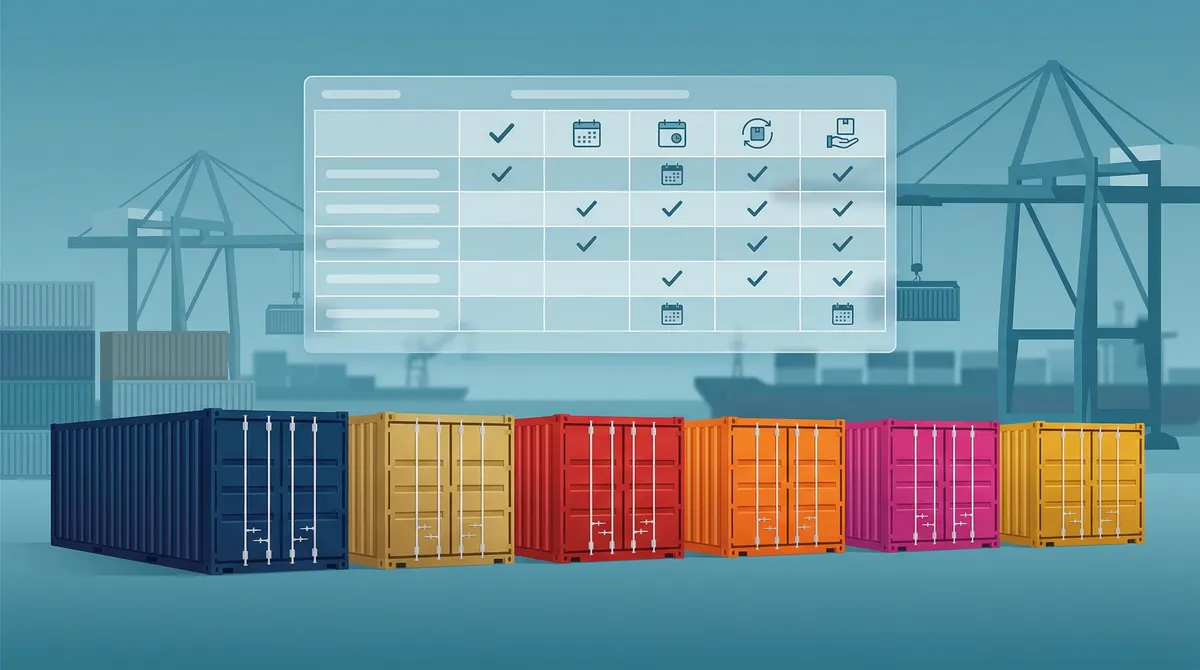
Key Takeaways
- ✓Carrier free days and demurrage rates vary significantly across SSLs — Maersk and CMA CGM are the most aggressive pricers (Tier 1 demurrage starting at $225–$250/day), while COSCO and Evergreen offer the most competitive tariff rates
- ✓Reefer containers get 1–2 fewer free days than dry at every major carrier — Maersk grants just 2 days for reefers vs. 4 for dry, and demurrage for reefer also carries a plug-in surcharge on top of the base rate
- ✓Most carriers count calendar days (weekends included), but CMA CGM excludes weekends at select US ports and Hapag-Lloyd excludes US federal holidays from the LFD — verify your specific tariff before planning drayage
- ✓Service contract rates routinely beat published tariff rates by 30–50% on both free day allowances and per-day charges — high-volume importers (200+ TEU/month per carrier) should always negotiate rather than accept tariff defaults
- ✓Under OSRA 2022 and 46 CFR Part 545, carriers cannot charge demurrage for periods when containers were inaccessible due to CBP holds, government exams, or terminal-caused delays — document those holds and dispute invoices that cover protected periods
Why Carrier Free Day Policies Matter More Than Freight Rates
Most freight forwarders and importers spend significant time negotiating ocean freight rates. Far fewer spend equal time negotiating demurrage terms — even though a single missed Last Free Day on a container stuck at APM Terminals Los Angeles can generate more cost than the freight savings from a competitive spot rate. A carrier free days comparison is not a compliance exercise; it is a financial risk assessment.
The eight major carriers covered in this guide — Maersk, MSC, CMA CGM, Hapag-Lloyd, ONE, ZIM, Evergreen, and COSCO — collectively move the vast majority of US import container volume. Each publishes its own demurrage and detention (D&D) tariff, and each sets its own free day allowances by container type, port, and shipment direction. The spread between the most generous and most aggressive carrier terms on Tier 3 demurrage (day 9+) exceeds $100/day per container. For an importer moving 500 containers per year, a carrier selection decision that ignores D&D terms is leaving real money on the table.
For background on how carrier (line) LFD interacts with terminal LFD and rail LFD, see the line vs. terminal vs. rail LFD guide. For the mechanics of tracking LFD across your entire container portfolio, see the complete LFD tracking guide.
Master Carrier Free Days Comparison Table
The table below consolidates published D&D tariff data for all eight major carriers at US import ports. Rates reflect each carrier's most recently published tariff as of Q1 2026. Dry container columns show standard 20' and 40' dry van free days. Reefer columns reflect refrigerated container free time. Demurrage tiers are carrier-side charges only — terminal storage is billed separately by the terminal operator.
| Carrier | Dry Free Days | Reefer Free Days | Tier 1 Rate | Tier 2 Rate | Tier 3 Rate | Weekend Policy | Source / Updated |
|---|---|---|---|---|---|---|---|
| Maersk | 4 days | 2 days | $225/day (days 1–4) | $350/day (days 5–8) | $450/day (day 9+) | Calendar days | Maersk D&D Tariff / Jan 2026 |
| MSC | 5 days | 3 days | $200/day (days 1–4) | $325/day (days 5–8) | $425/day (day 9+) | Calendar days | MSC Tariff Circular / Feb 2026 |
| CMA CGM | 4 days | 2 days | $250/day (days 1–4) | $375/day (days 5–8) | $475/day (day 9+) | Weekends excluded at select ports | CMA CGM D&D Schedule / Jan 2026 |
| Hapag-Lloyd | 5 days | 3 days | $200/day (days 1–4) | $300/day (days 5–8) | $400/day (day 9+) | US holidays excluded | Hapag-Lloyd D&D Tariff / Jan 2026 |
| ONE | 5 days | 3 days | $195/day (days 1–4) | $295/day (days 5–8) | $395/day (day 9+) | Calendar days | ONE D&D Rate Sheet / Q4 2025 |
| ZIM | 4 days | 2 days | $225/day (days 1–4) | $350/day (days 5–8) | $425/day (day 9+) | Calendar days | ZIM Tariff / Jan 2026 |
| Evergreen | 5 days | 3 days | $190/day (days 1–4) | $290/day (days 5–8) | $390/day (day 9+) | Calendar days | Evergreen Tariff Enquiry / Jan 2026 |
| COSCO | 5 days | 3 days | $185/day (days 1–4) | $285/day (days 5–8) | $385/day (day 9+) | Calendar days | COSCO USA Tariff / Q4 2025 |
Rates reflect published tariff defaults for US import dry container demurrage at standard US gateway ports. Contract rates negotiated via service agreement may differ substantially. Reefer demurrage is charged at the same tier rates with an additional plug-in/monitoring surcharge layered on top (see reefer sections below for carrier-specific details). All data as of Q1 2026.
Carrier-by-Carrier Policy Breakdown
The master table above gives you the numbers. The sections below give you the operational context: how each carrier structures its tariff, what the edge cases are, which ports carry different rates, and what to watch for when booking on each SSL.
Maersk
Maersk is the world's largest container carrier by deployed TEU and operates the most transparent D&D disclosure process of any SSL serving the US market. Per Maersk's January 2026 D&D tariff update, standard US import dry containers receive 4 calendar days of free time from the vessel discharge date. Reefer containers receive just 2 days — the tightest reefer window among the big eight — plus a plug-in surcharge of $75–$100/day on top of base demurrage while the reefer remains connected to shore power at the terminal.
Maersk demurrage escalates steeply: $225/day through day 4 over LFD, $350/day through day 8, and $450/day from day 9 onward. For a 40' container spending 10 days in demurrage, that is $225 × 4 + $350 × 4 + $450 × 2 = $3,200 in carrier-side charges alone, before terminal storage begins stacking. Maersk's Tier 3 rate of $450/day is the highest in the industry at published tariff levels.
Key Maersk ports where rates differ from the standard schedule: Savannah and Houston run $200/$325/$425 rather than the $225/$350/$450 applied at LA, Long Beach, and NY/NJ. Maersk counts all calendar days — weekends and US federal holidays included. The container number prefixes to know are MAEU (primary Maersk fleet) and MRKU (Safmarine, which operates under Maersk). For a detailed walkthrough of checking LFD in Maersk's portal and API, see the Maersk LFD guide.
MSC
Mediterranean Shipping Company, now the world's largest carrier by fleet capacity, publishes its D&D tariffs through local office circulars rather than a single centralized web page — which makes MSC tariff verification more cumbersome than Maersk. Per MSC's February 2026 tariff circular for US ports, standard dry containers receive 5 calendar days of free time, and reefers receive 3 days. At $200/$325/$425 across three tiers, MSC's published rates sit at the mid-range for large carriers.
MSC's container prefix (MSCU) and Medlog containers (MEDU) are the most common identifiers. MSC routes volume through a wide range of terminals, including LBCT in Long Beach (which MSC recently acquired a stake in), Maher Terminals in Newark, and Garden City Terminal in Savannah. Tariff rates are uniform across most US ports, but verify via your MSC regional office for Gulf and Pacific Northwest terminals where MSC has less frequent service.
MSC processes LFD extension requests through regional office email rather than a centralized portal — which means response time varies by office. Submit extension requests 48–72 hours before LFD expiry. MSC is generally responsive when supported by CBP exam notices or government hold documentation, consistent with its obligations under 46 CFR Part 545.
CMA CGM
CMA CGM — the world's third-largest carrier, which also owns APL and operates significant APLU container volume through the US — runs the highest published Tier 1 tariff rate in the industry at $250/day. Combined with a 4-day dry free window and a 2-day reefer window, CMA CGM's tariff is the most aggressive of the major carriers for importers who miss LFD. Per CMA CGM's January 2026 D&D schedule, Tier 2 runs $375/day and Tier 3 reaches $475/day — the highest Tier 3 rate across all eight carriers.
The significant CMA CGM distinction is its weekend policy: at select US ports (notably Los Angeles/Fenix Marine Services, where CMA CGM has a dedicated terminal stake), weekend days are excluded from the free day count. This means a 4-day free time allowance at those ports effectively extends to a 6-calendar-day window when a weekend falls within the free period. Always verify whether your specific CMA CGM booking and terminal qualifies for weekend exclusion — it is not applied uniformly across all US ports.
CMA CGM container prefixes include CMAU, CGMU, and APLU (for APL cargo). CMA CGM's D&D tariff is published in their Local Charges by Port tool on cma-cgm.com, accessible by selecting the US port of discharge.
Hapag-Lloyd
Hapag-Lloyd's published tariff is among the more importer-friendly in the group on a rate basis: $200/$300/$400 across three tiers, with 5 dry days and 3 reefer days as the standard allowance. Per Hapag-Lloyd's January 2026 D&D tariff, US federal holidays are excluded from the LFD calculation — meaning an LFD that falls on, say, Thanksgiving Day is automatically pushed to the following business day. This is a meaningful operational benefit for importers with freight arriving around US holiday periods.
Hapag-Lloyd serves the US market through a mix of proprietary and third-party terminals. Key US terminals include SSA Marine / Total Terminals International (TTI) in Long Beach, Port Newark Container Terminal (PNCT) in New Jersey, and Husky Terminal in Tacoma. Hapag-Lloyd acquired Hamburg Sud in 2017, so legacy Hamburg Sud bookings (SUDU prefix) operate under Hapag-Lloyd terms. Container prefixes: HLCU (primary), SUDU (Hamburg Sud legacy).
Hapag-Lloyd's online D&D tariff tool is one of the more user-friendly on the market, accessible via Hapag-Lloyd.com → Online Business → Tariffs → Demurrage & Detention. You can filter by port of discharge and container type to pull the exact applicable rate.
ONE (Ocean Network Express)
Ocean Network Express, formed in 2018 from the merger of the container divisions of K Line, MOL, and NYK, operates the fifth-largest fleet globally. Per ONE's Q4 2025 D&D rate sheet for US ports, standard dry containers receive 5 calendar days of free time and reefers receive 3 days. Tiered rates of $195/$295/$395 are the second-lowest among major carriers, making ONE one of the more cost-effective options from a demurrage exposure standpoint for importers who occasionally miss LFD.
ONE's US terminal footprint runs through TraPac Los Angeles, Pacific Container Terminal (PCT) in Long Beach, PNCT in Newark, and Washington United Terminals (WUT) in Tacoma. Container prefix: ONEY. ONE publishes its D&D rates through one-line.com → Tools → Tariff → D&D Rates, filterable by trade lane and port.
ZIM
ZIM is the smallest carrier in this comparison by fleet, but it has grown its US market share significantly through its focus on niche trades and premium service. ZIM's published D&D tariff as of January 2026 mirrors Maersk's free day structure: 4 days for dry, 2 days for reefer, calendar day counting throughout. Demurrage rates of $225/$350/$425 are slightly below Maersk's Tier 3 but otherwise equivalent in structure.
ZIM differentiates from other carriers through its early adoption of blockchain-based Bill of Lading issuance (ZIMtradeX) and its technology-forward carrier portal. ZIM container prefix: ZIMU. ZIM serves the US primarily through West Basin Container Terminal (WBCT) in Los Angeles, Pacific Container Terminal in Long Beach, and GCT Bayonne in New Jersey. ZIM's tariff is accessible via ZIM.com → Customer Center → Tariffs.
Evergreen
Evergreen Marine Corporation — the Taiwanese carrier widely recognized for operating one of the vessels involved in the 2021 Suez Canal blockage (Ever Given) — offers among the most competitive published tariff rates in the comparison. Per Evergreen's January 2026 tariff enquiry data, standard dry containers receive 5 calendar days and reefers 3 days. Demurrage tiers run $190/$290/$390 — second only to COSCO as the lowest-cost published tariff among major carriers.
Evergreen serves the US through Fenix Marine Services in Los Angeles, ITS Terminal in Long Beach, Everport Terminal Services in Oakland, and GCT Bayonne in New Jersey. Container prefix: EISU, EMCU. Evergreen tariff rates are accessible via evergreen-line.com → Customer Service → Tariff Enquiry, where you select the US port of discharge and container type.
COSCO
COSCO Shipping, the state-owned Chinese carrier, operates the lowest published tariff rates among major carriers at $185/$285/$385 across three tiers, per COSCO USA's Q4 2025 tariff. Standard dry containers receive 5 calendar days and reefers 3 days. At Tier 3, COSCO's $385/day rate is $65/day below Maersk's and $90/day below CMA CGM's — a meaningful difference for importers with chronic LFD issues.
COSCO's US terminal presence includes WBCT in Los Angeles, ITS in Long Beach, and GCT Bayonne. COSCO container prefixes include COSU (primary) and CCLU (COSCO Container Lines). COSCO acquired OOCL in 2018, so OOLU-prefix containers (OOCL) now operate under COSCO's umbrella. COSCO D&D tariffs are accessible via cosco-usa.com → Tools → Tariff.
Detention vs. Demurrage: What Each Carrier Charges for Each
Demurrage and detention are related but distinct charges. Demurrage is the carrier's charge for a container that remains at the terminal beyond the free time window — you're holding the carrier's box at the port. Detention is the carrier's charge for a container that has been removed from the terminal but not yet returned to a depot — you're holding the carrier's box off-port. Both charges are governed by the carrier's D&D tariff, but they operate on separate clocks and separate free time allowances.
The distinction matters because many importers with efficient drayage operations — containers picked up promptly — still incur detention charges if they cannot unload and return the equipment within the carrier's off-terminal free time window. Inland locations with limited transloading capacity or small distribution centers with limited dock availability are particularly vulnerable.
| Carrier | Demurrage Free Days (Dry) | Demurrage Tier 1 Rate | Detention Free Days (Dry) | Detention Tier 1 Rate | Combined D&D Free Days | Tariff Updated |
|---|---|---|---|---|---|---|
| Maersk | 4 days | $225/day | 5 days | $150/day | 9 days (combined) | Jan 2026 |
| MSC | 5 days | $200/day | 5 days | $135/day | 10 days (combined) | Feb 2026 |
| CMA CGM | 4 days | $250/day | 4 days | $165/day | 8 days (combined) | Jan 2026 |
| Hapag-Lloyd | 5 days | $200/day | 5 days | $130/day | 10 days (combined) | Jan 2026 |
| ONE | 5 days | $195/day | 5 days | $125/day | 10 days (combined) | Q4 2025 |
| ZIM | 4 days | $225/day | 4 days | $140/day | 8 days (combined) | Jan 2026 |
| Evergreen | 5 days | $190/day | 5 days | $120/day | 10 days (combined) | Jan 2026 |
| COSCO | 5 days | $185/day | 5 days | $115/day | 10 days (combined) | Q4 2025 |
Detention free days and rates reflect published tariff defaults for standard US import dry containers. Combined D&D free days indicate the total window across both demurrage and detention when structured as separate (not combined) free time. Some carriers offer combined D&D free time pools as a contract option — all days draw from a single pool rather than separate demurrage and detention counts. See negotiation section below for how to structure a combined D&D pool in contract negotiations.
Reefer Container Free Days by Carrier
Reefer demurrage deserves its own analysis because the financial exposure per container is substantially higher than for dry cargo. Every major carrier grants fewer free days for reefer than for dry. Maersk and CMA CGM grant just 2 reefer days; MSC, Hapag-Lloyd, ONE, Evergreen, and COSCO grant 3. Base demurrage rates apply equally to dry and reefer containers from the tier structure, but reefer containers also incur plug-in surcharges while connected to shore power at the terminal.
| Carrier | Reefer Free Days | Reefer Tier 1 Demurrage | Reefer Plug-in Surcharge | Total Reefer Exposure (Day 1) | Weekend / Holiday Counting |
|---|---|---|---|---|---|
| Maersk | 2 days | $225/day | $75–$100/day | $300–$325/day | Calendar days |
| MSC | 3 days | $200/day | $60–$90/day | $260–$290/day | Calendar days |
| CMA CGM | 2 days | $250/day | $80–$100/day | $330–$350/day | Weekends excluded (select ports) |
| Hapag-Lloyd | 3 days | $200/day | $65–$85/day | $265–$285/day | Holidays excluded |
| ONE | 3 days | $195/day | $60–$80/day | $255–$275/day | Calendar days |
| ZIM | 2 days | $225/day | $70–$90/day | $295–$315/day | Calendar days |
| Evergreen | 3 days | $190/day | $60–$80/day | $250–$270/day | Calendar days |
| COSCO | 3 days | $185/day | $55–$75/day | $240–$260/day | Calendar days |
Plug-in surcharges are billed by the terminal, not the carrier, in most cases — but the carrier's tariff typically references the surcharge because it is included in the total D&D invoice. Verify the billing structure with your carrier's local office at the port of discharge, as some terminals invoice reefer monitoring fees independently.
For food-grade reefer importers — particularly those moving fresh produce, seafood, or pharmaceutical cargo through USDA or FDA-regulated ports of entry — the 2-day reefer window at Maersk, CMA CGM, and ZIM is operationally insufficient during peak seasons or when customs examinations are triggered. Negotiating 4–5 reefer days in a service contract is standard practice for high-volume reefer shippers and should be a baseline ask in any carrier tender.
How to Negotiate Better Free Day Terms with Carriers
Published tariff rates are starting points, not final answers. Every major carrier will negotiate free day allowances and demurrage rates for shippers moving sufficient volume. The FMC does not prohibit carrier rate negotiations — it requires that negotiated rates be reflected in a service contract filed with the FMC (or, post-OSRA 2022, accessible under the updated service contract transparency requirements). Knowing what each carrier will actually negotiate versus what they publish is the most actionable intelligence in this space.
Volume Thresholds That Trigger Negotiating Power
The general threshold for meaningful D&D negotiation is 200 TEU per month with a single carrier at a named port or port cluster. Below that volume, carriers are unlikely to deviate from tariff defaults on free days, though they may offer modest rate reductions (5–10%) on per-day charges. Above 500 TEU/month, shippers regularly secure 7–10 dry free days and 4–5 reefer free days — more than double the tariff default — plus tiered rate reductions of 20–40%.
Carriers incentivize volume concentration. A shipper splitting 400 TEU/month across four carriers gets nothing from any of them. The same shipper consolidating 300 TEU/month onto one carrier gets negotiating leverage. This dynamic is worth factoring into carrier selection decisions when your annual volumes approach the thresholds above.
What to Ask for in Contract Negotiations
Structure your asks in order of importance. Extended free days are more valuable than reduced per-day rates — an extra 3 free days at $225/day represents $675 in avoided cost per container, which compounds across your container volume faster than a 10% rate reduction from $225 to $202.50. The priority list for contract negotiations:
- Extended dry free days: Target 7–10 days rather than the 4–5 tariff default. Even 2 extra days eliminates the most common demurrage trigger — containers that clear customs on day 3 but cannot get a drayage appointment until day 6.
- Extended reefer free days: Target 4–5 days for reefer. The 2-day default at Maersk, CMA CGM, and ZIM is operationally unworkable during USDA or FDA exam periods.
- Combined D&D free time pool: Rather than separate demurrage and detention clocks, negotiate a single combined pool of free time (e.g., 14 combined days for demurrage + detention). This eliminates the cliff where detention starts immediately after pickup even if you still had demurrage days unused.
- Port-specific free day extensions: If your cargo moves through notoriously congested terminals (LA/LB complex, NY/NJ Maher Terminals), negotiate port-specific addenda with extra days at those locations.
- Rate tier reductions: Target reducing Tier 1 rate by 15–25% and capping Tier 3 at a fixed ceiling. Unlimited escalation into $450/day+ territory is where the real financial risk lives.
OSRA 2022 Protections That Reduce Negotiating Risk
Even without a negotiated service contract, OSRA 2022 — the Ocean Shipping Reform Act signed into law in 2022 — provides baseline protections that reduce carrier D&D exposure for importers. Under 46 CFR Part 545 (the FMC's implementing rule), ocean carriers cannot lawfully charge demurrage for periods when:
- The container was under a CBP customs examination or government-directed hold
- The terminal was closed or inaccessible due to labor action, equipment failure, or weather events
- The container was not made available to the shipper at the applicable terminal (e.g., lost cargo, terminal computer outage preventing pickup scheduling)
- The carrier failed to provide required D&D billing transparency under 46 CFR Part 545's notice requirements
These protections are codified — carriers cannot waive them via tariff language. If you receive a demurrage invoice that covers a period when any of these conditions applied, you have grounds for a formal dispute with the carrier and, if the carrier refuses to adjust, a complaint filing with the FMC. The FMC's Consumer Affairs and Dispute Resolution Services (CADRS) offers a structured mediation process for D&D disputes at no cost to the shipper.
Published Tariff vs. Service Contract: What the Gap Looks Like
The difference between tariff and contract terms is not trivial. The following table compares what a high-volume importer (300 TEU/month, 2-year commitment) can realistically negotiate against tariff defaults for each carrier, based on industry norms as of Q1 2026. Actual contract terms vary by carrier, trade lane, cargo type, and negotiation skill — use this as a baseline for what is achievable, not a guarantee.
| Carrier | Tariff Dry Free Days | Contract Dry Free Days (Typical) | Tariff Tier 1 Rate | Contract Tier 1 Rate (Typical) | Annual Savings Est. (300 TEU/mo) |
|---|---|---|---|---|---|
| Maersk | 4 days | 7–10 days | $225/day | $150–$175/day | $200,000–$350,000+ |
| MSC | 5 days | 8–10 days | $200/day | $130–$160/day | $150,000–$280,000+ |
| CMA CGM | 4 days | 7–10 days | $250/day | $160–$190/day | $220,000–$400,000+ |
| Hapag-Lloyd | 5 days | 8–12 days | $200/day | $130–$155/day | $150,000–$300,000+ |
| ONE | 5 days | 8–12 days | $195/day | $125–$150/day | $130,000–$260,000+ |
| ZIM | 4 days | 7–10 days | $225/day | $145–$170/day | $180,000–$320,000+ |
| Evergreen | 5 days | 8–10 days | $190/day | $120–$145/day | $120,000–$240,000+ |
| COSCO | 5 days | 8–12 days | $185/day | $115–$140/day | $110,000–$220,000+ |
Annual savings estimates assume 300 TEU/month, 30% of containers incurring at least 2 days of demurrage at tariff rates, and contract terms achieving the mid-range of negotiated rates shown. Actual results depend on operational efficiency, cargo mix, and port performance. Estimates are illustrative, not guaranteed.
The savings potential on the table above is what makes carrier D&D negotiations worth prioritizing alongside freight rate discussions. For a port-by-port breakdown of how terminal storage free days layer on top of these carrier terms, see the US port free days comparison.
Carrier Portal and API Comparison
Beyond rate terms, operational LFD management depends on how easily you can access LFD data from each carrier's systems. Carrier portals and APIs vary significantly in usability, data latency, and programmatic accessibility. The following summary covers the practical access landscape as of Q1 2026.
| Carrier | Portal LFD Visibility | API Available | API Authentication | LFD Extension Process | LFD Data Latency Post-Discharge |
|---|---|---|---|---|---|
| Maersk | Full D&D panel in portal | Yes (developer.maersk.com) | OAuth 2.0 + API key | Online portal form | 2–4 hours |
| MSC | Displayed in Track & Trace | Limited (partner integration) | Partner agreement required | Regional office email | 4–8 hours |
| CMA CGM | Via MyCMA CGM portal | Yes (CMA CGM API Platform) | OAuth 2.0 | Customer service ticket | 2–6 hours |
| Hapag-Lloyd | Full D&D detail available | Yes (developer.hapag-lloyd.com) | API key | Portal request form | 2–4 hours |
| ONE | Displayed post-discharge | Limited (eAPI program) | Proprietary credentials | Customer service email | 4–8 hours |
| ZIM | Via ZIM portal (myZIM) | Yes (ZIM API) | API key | Portal or customer service | 4–6 hours |
| Evergreen | Basic status only | Limited | EDI / partner agreement | Customer service email | 6–12 hours |
| COSCO | Displayed in tracking portal | Limited (EDI primarily) | EDI / partner agreement | Customer service email | 6–12 hours |
The operational implication of this table: if your freight mix includes significant Evergreen or COSCO volume, you cannot rely on direct API integration for real-time LFD data. Third-party LFD tracking platforms that aggregate data from multiple carrier EDI feeds and APIs fill this gap, providing a unified view regardless of how technically accessible each individual carrier is. For operations teams managing containers across multiple carriers simultaneously, multi-carrier aggregation is the only scalable approach.
Data Sources: Carrier D&D Tariff Pages
D&D tariff schedules change quarterly at minimum and can be updated at any time with advance notice. The following are the authoritative primary sources for each carrier's current terms. Always verify against the live tariff before committing to a pickup schedule, especially for high-value or time-sensitive cargo where demurrage exposure is significant.
- Maersk: Maersk.com → Local Information → United States → Tariff — updated January 2026. Includes per-port D&D rate schedules and free day allowances by container type.
- MSC: MSC.com → Tools → Tariffs → Local Charges — search by US port of discharge. Updated February 2026 via tariff circular. Contact local MSC office for reefer plug-in surcharge details.
- CMA CGM: CMA-CGM.com → Tools → Local Charges by Port — select United States and port of discharge. Updated January 2026. Includes weekend exclusion notation for applicable ports.
- Hapag-Lloyd: Hapag-Lloyd.com → Online Business → Tariffs → Demurrage & Detention — updated January 2026. The most user-friendly D&D tariff interface among major carriers, with port-specific filtering.
- ONE: one-line.com → Tools → Tariff → D&D Rates — updated Q4 2025. Search by trade lane (Asia-US West Coast, Asia-US East Coast, etc.) and container type.
- ZIM: ZIM.com → Customer Center → Tariffs — updated January 2026. ZIM's tariff page includes both demurrage and detention schedules in a single downloadable PDF per US port.
- Evergreen: evergreen-line.com → Customer Service → Tariff Enquiry — updated January 2026. Portal-based lookup by origin country, destination country, and port.
- COSCO: cosco-usa.com → Tools → Tariff — updated Q4 2025. Includes OOCL (COSCO subsidiary) tariff schedules accessible via the same interface.
The Federal Maritime Commission's demurrage and detention resource page is the authoritative regulatory reference. It covers the FMC's interpretive rule under OSRA 2022, the billing transparency requirements under 46 CFR Part 545, and guidance on filing complaints against carriers whose D&D practices violate the Shipping Act. For importers navigating a disputed demurrage invoice — particularly one covering a CBP exam hold period — the FMC page is the starting point for understanding your rights.
For a complete framework on tracking all three types of LFD — carrier, terminal, and rail — across your full container portfolio, see the LFD tracking guide. For understanding how terminal storage free days interact with the carrier rates above at specific US port terminals, see the US port free days comparison.