
Key Takeaways
- ✓Line LFD (carrier demurrage) and terminal LFD (terminal storage) are set by different entities and run on independent clocks — both can be accruing charges simultaneously
- ✓The earliest expiring LFD determines when you start paying — tracking only one type leaves you exposed to the other
- ✓Rail LFD is the most overlooked and least forgiving: free time is typically just 2–4 days with almost no extension flexibility
- ✓When line LFD and terminal LFD disagree, you can owe terminal storage even while carrier free time still appears active
- ✓A functional LFD tracking workflow requires monitoring all three types across every active container — manual portal-checking doesn't scale past 20 containers
Three LFDs, One Container — Why This Matters
Most freight forwarders are managing at least two LFD deadlines per container — and for intermodal shipments, three. Understanding line LFD vs terminal LFD is not an academic exercise: confusing the two is one of the most common and most expensive mistakes in import logistics. A container can expire its terminal free time while the carrier portal still shows days remaining, and demurrage invoices will arrive from both parties regardless of which one you were watching.
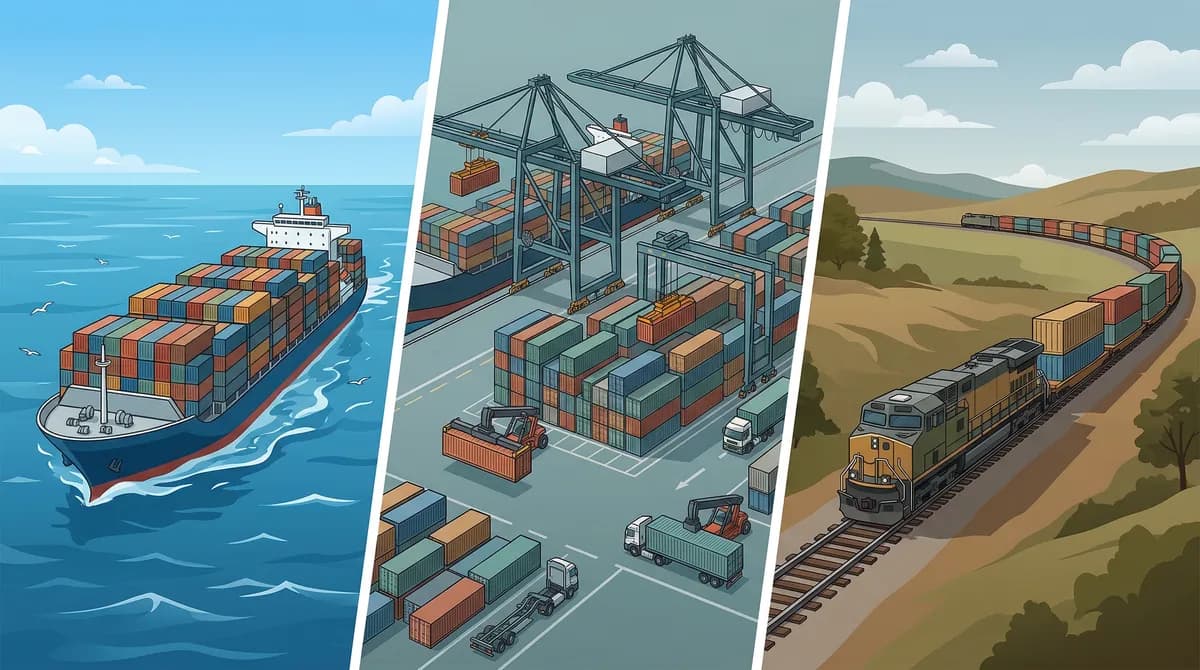
Every import container at a US port is subject to up to three independent free-time clocks running simultaneously. The ocean carrier (shipping line or SSL) sets one. The terminal operator sets another. For any cargo that moved by rail before arriving at its final destination, the railroad sets a third. Each has its own start date, its own day count, its own rate schedule, and its own escalation tiers.
The operational rule is simple: whichever clock expires first is the one that costs you money. A container with a carrier LFD of March 14 and a terminal LFD of March 11 will begin accruing terminal storage charges on March 12 — even though the carrier still shows three free days remaining. Both clocks are live and both charges stack.
Quick Definition of Each LFD Type
Line LFD (Carrier Free Time / Demurrage)
Line LFD — also called carrier LFD, carrier free time, or simply demurrage — is the deadline set by the ocean carrier. It defines how long a carrier will allow its equipment (the container) to sit at the port terminal before charging demurrage. The charge is technically for holding the carrier's container, not for using the terminal's land.
The clock typically starts on the discharge date — the day the container is unloaded from the vessel onto the terminal. Carriers like Maersk, MSC, CMA CGM, Hapag-Lloyd, ONE, and ZIM each publish their free day allowances in their public tariffs, though negotiated service contracts frequently override these. Standard allowances at US ports run 4–7 days for dry containers, 2–4 for reefers.
Terminal LFD (Terminal Storage / Wharfage)
Terminal LFD is the deadline set by the terminal operator — not the shipping line. Terminals like APM Terminals (LA and Elizabeth), LBCT, Garden City Terminal in Savannah, or GCT Bayonne operate independently of the ocean carriers. They set their own free time allowances for how long a container can sit in the yard before storage fees kick in.
Terminal free time typically starts from the container's availability date — the date it has been discharged, cleared customs (if required), and is physically ready for pickup. This is sometimes later than the discharge date, which creates a meaningful difference: the carrier's clock may have already been running for 24–48 hours before the terminal's clock starts. Terminal storage rates are separate line items on your invoice, billed by the terminal directly (or passed through your drayage carrier), not by the shipping line.
Rail LFD (Rail Free Time / Rail Storage)
Rail LFD applies to domestic intermodal containers that travel by rail before reaching their final destination. Railroads — BNSF, Union Pacific, Norfolk Southern, and CSX — provide a short free-time window after a container is unloaded at an inland rail ramp before storage charges begin. This is sometimes called "rail per diem" or "ramp free time."
Rail LFD is the least forgiving of the three types. Free time is often just 24–48 hours after notification, with storage fees that escalate quickly. The railroad notifies the cargo owner or their agent when the container is available, and the free-time clock starts from that notification — not from when the train actually arrived at the ramp.
Side-by-Side Comparison: Line LFD vs Terminal LFD vs Rail LFD
| Attribute | Line LFD (Carrier) | Terminal LFD | Rail LFD |
|---|---|---|---|
| Who sets it | Ocean carrier (Maersk, MSC, CMA CGM, Hapag-Lloyd, ONE, ZIM) | Terminal operator (APM Terminals, LBCT, Garden City Terminal, GCT Bayonne) | Railroad (BNSF, Union Pacific, Norfolk Southern, CSX) |
| Charge name | Demurrage | Terminal storage / wharfage | Rail storage / per diem / ramp storage |
| Clock starts | Vessel discharge date (Day 0 or Day 1 depending on carrier) | Container availability date (when ready for pickup) | Railroad notification to consignee / agent |
| Typical free days (dry import) | 4–7 days | 3–5 days | 24–96 hours (1–4 calendar days) |
| Typical free days (reefer) | 2–4 days | 2–3 days | 24–48 hours |
| Where to find the LFD | Carrier online portal, B/L details, EDI, or API | Terminal website, terminal availability system (TAS), EDI | Railroad customer portal (e.g., BNSF.com, MyUPRR), EDI 315 |
| Weekend / holiday handling | Varies — Maersk and MSC use calendar days; CMA CGM excludes weekends at some ports | Usually calendar days; some terminals exclude Sundays | Calendar days from notification; no holiday exceptions in most tariffs |
| Extension possible? | Yes — via carrier portal or local office, before LFD expires | Rarely; some terminals allow one-time extensions for documented delays | Extremely rare; typically no extension policy |
| Invoiced by | Ocean carrier directly | Terminal operator (directly or via drayage carrier) | Railroad (directly or via intermodal marketing company) |
| OSRA 2022 protection applies? | Yes — carrier demurrage subject to FMC incentive principle | Partially — terminal storage has separate regulatory framework | No — rail charges governed by STB, not FMC |
For foundational context on how LFD works, see our complete reference guide: The Ultimate Guide to Last Free Day (LFD) Tracking. For carrier-by-carrier free day allowances, see Carrier Free Days Comparison.
Real-World Scenario: When Line LFD and Terminal LFD Disagree
This is where freight forwarders get burned. Let's walk through a concrete example that plays out dozens of times every day at the Port of Los Angeles.
The Setup
Container HLBU1234567 arrives at APM Terminals, Pier 400, Port of Los Angeles on a Hapag-Lloyd vessel. The vessel discharges containers over a two-day window. HLBU1234567 is unloaded on Monday, March 10.
- Carrier (Hapag-Lloyd) free days: 5 calendar days from discharge
- Hapag-Lloyd Line LFD: Saturday, March 15
- APM Terminals free days: 4 calendar days from availability date
Here's where the split happens: HLBU1234567 holds a customs exam order. The container doesn't clear CBP until Wednesday, March 12, and APM marks it as "available for pickup" that same day.
- APM Terminals availability date: Wednesday, March 12
- APM Terminal LFD: Saturday, March 15 (4 days from March 12)
In this case, both LFDs align on March 15 — but only because the customs exam ate two days. Now let's change one variable.
The Split — What Actually Happens
Same container, same Hapag-Lloyd vessel. But this time, CBP doesn't pull the container for exam. It discharges Monday, March 10, and is available at APM Terminals immediately — same day.
- Hapag-Lloyd Line LFD: Saturday, March 15 (5 days from March 10)
- APM Terminal LFD: Friday, March 14 (4 days from March 10, availability = discharge date)
Your drayage is booked for Saturday, March 15. You checked the Hapag-Lloyd portal — it shows March 15. You're fine, right? Wrong.
You're fine on Hapag-Lloyd demurrage. But APM Terminals' free time expired on March 14. Saturday pickup means one full day of terminal storage — APM Terminals charges $80/day for dry 20' on Day 1, scaling to $150/day by Day 5. That's an $80 charge per container that appeared out of nowhere because you were only tracking the carrier LFD.
Scale that across 50 containers per week where drayage is routinely booked on the carrier LFD rather than the terminal LFD, and you have a $4,000/week problem — $200,000/year — that your team has been invisibly absorbing.
The Inverse Case
The reverse scenario is also common. MSC regularly offers 5 free days at LA/LB while many terminals only allow 4. A container discharged Friday, March 7 has an MSC Line LFD of Wednesday, March 12. The terminal LFD at LBCT is Tuesday, March 11. If your team sees the carrier LFD of March 12 and books pickup for that day, you've missed the terminal deadline by one day.
The practical rule: always pick up by whichever LFD is earlier — the line LFD or the terminal LFD. Never use the carrier LFD as your scheduling target without also confirming the terminal LFD.
The Numbers Behind the Problem
The financial scale of demurrage and detention charges at US ports puts the tracking gap in context. According to FMC data, carriers collected billions in demurrage and detention fees during peak congestion years. A 2022 FMC study found that demurrage charges were among the top three operational cost complaints from US importers and freight forwarders, with a significant portion attributed to inadequate visibility into LFD — not actual cargo delays.
- Average demurrage charge per container at Port of LA/LB: $350–$600 when LFD is missed by 2+ days
- A freight forwarder managing 200 containers/month who avoids LFD misses on even 5% of shipments saves an estimated $10,000–$20,000/month
- Terminal storage charges at APM Terminals (Pier 400) run $80/day (Days 1–4), $130/day (Days 5–7), and $200/day (Day 8+) — separate from carrier demurrage
- Rail storage charges at BNSF intermodal ramps can reach $150–$225/day after the short free-time window expires, with virtually no dispute mechanism
The operational insight is that most of these charges are preventable with adequate visibility — not by negotiating better rates, but simply by knowing the right deadline before the truck is dispatched.
Rail LFD: The Overlooked Third Layer
Rail LFD is the one that blindsides importers most often. When a container moves via intermodal rail from a port to an inland ramp — say, from the Port of LA to a BNSF facility in Chicago or Dallas — a third free-time clock activates at the ramp. Most freight forwarders who track line LFD and terminal LFD at the port have no system at all for monitoring rail LFD at the inland destination.
How Rail Free Time Works
When the railroad delivers a container to an inland ramp (intermodal container transfer facility or ICTF), it sends a notification — typically an EDI 315 message or an email — to the cargo owner or their designated agent. Free time begins from the date and time of that notification, not from when the train physically arrived. Free time windows are usually 24–96 hours, though this varies by railroad and contract.
BNSF, the largest intermodal railroad serving West Coast imports destined for the Midwest and Southeast, typically allows 48 hours of free time at most ramp locations before storage begins. Union Pacific offers similar windows. Norfolk Southern and CSX handle East Coast intermodal volume with comparable short free-time allowances. None of these railroads are known for flexibility on extensions — the free time is short, the notice period is short, and the charges start immediately.
Rail Storage Rates
Rail storage charges vary by railroad, ramp location, and container size. As a general benchmark:
| Railroad | Typical Free Time | Storage Day 1–3 | Storage Day 4–7 | Storage Day 8+ |
|---|---|---|---|---|
| BNSF | 48 hours from notification | $75–$125/day | $125–$175/day | $175–$225/day |
| Union Pacific | 48 hours from notification | $80–$130/day | $130–$180/day | $180–$230/day |
| Norfolk Southern | 24–48 hours from notification | $70–$115/day | $115–$165/day | $165–$215/day |
| CSX | 24–48 hours from notification | $70–$110/day | $110–$160/day | $160–$210/day |
Rates are approximate, based on published BNSF and Union Pacific intermodal tariff schedules as of Q1 2026. Actual charges vary by ramp location, container size, and contract terms. Verify with the railroad directly or via the intermodal marketing company (IMC) booking the rail segment.
The Visibility Problem for Rail LFD
The core challenge with rail LFD tracking is that the notification chain is often broken. The railroad sends the availability notice to whoever their customer of record is — often the IMC, the ocean carrier, or the NVOCC. That notification may or may not cascade down to the actual freight forwarder or cargo owner in time to arrange pickup. By the time the importer learns the container is at the ramp, 24 of their 48 free hours may already be gone.
Building a rail LFD tracking workflow requires knowing: (a) which railroad is handling the intermodal leg, (b) the target ramp location, (c) who receives the notification, and (d) the specific free time allowance in the applicable rail tariff. For most importers, this means building a direct relationship with the IMC or railroad customer service rather than relying on notification pass-through.
Which LFD Should You Track? All of Them
The question of "which LFD matters" has a definitive answer: all of them, simultaneously, for every active container. There is no shortcut that adequately substitutes for tracking all three types. Here is why each one is indispensable:
Why You Must Track Line LFD
Line LFD governs carrier demurrage — typically the largest single charge per container when missed. Carrier demurrage rates are tiered and escalate aggressively: a Maersk container going 8 days over LFD accumulates $225/day for the first four days and $350/day for the next four, totaling $2,300 per container before the highest tier kicks in. You cannot negotiate this after the fact without OSRA-compliant grounds for dispute.
Why You Must Track Terminal LFD
Terminal storage charges are billed separately and often arrive as a surprise on the drayage invoice rather than directly from the terminal. The terminal LFD frequently differs from the carrier LFD, sometimes by one day, sometimes by three or four days. Any workflow that uses only the carrier LFD as a scheduling target will systematically generate terminal storage charges on a meaningful percentage of containers.
Why You Must Track Rail LFD
Rail LFD has no safety net. There are no effective extensions, no OSRA-style dispute protections, and no tolerance for late pickup at busy inland ramps. Missing rail free time by even 24 hours on a 20-foot container adds $75–$125 to the freight cost — and if the container sits for a week, you're looking at $700–$1,400 in rail storage that compounds with any remaining carrier demurrage still accruing on the box.
How to Build an LFD Tracking Workflow That Covers All Three
A functional three-LFD tracking workflow is achievable for any size freight forwarding operation. The architecture has five components:
1. Centralized Data Collection
Every container needs three data points captured at the time of booking: the ocean carrier (for line LFD), the port terminal (for terminal LFD), and the inland rail destination and railroad if applicable (for rail LFD). These should be populated in your TMS or a dedicated container tracking system before the vessel arrives — not after discharge.
2. Connect to the Right Sources
Line LFD: pull from each carrier's portal or API. Carrier portals update LFD in real time as the vessel itinerary changes. An API integration — directly with carriers like Maersk, MSC, Hapag-Lloyd, CMA CGM, ONE, or ZIM, or via an aggregation provider — gives you real-time data without manual portal checks.
Terminal LFD: terminal availability systems (TAS) at most major terminals are publicly accessible. APM Terminals, LBCT, Garden City Terminal in Savannah, and GCT Bayonne all publish availability and free time data online. Some terminal operators expose this data via EDI or APIs.
Rail LFD: monitor your EDI 315 feed if you have one, or check the railroad customer portal directly (BNSF.com, MyUPRR). Many forwarders also set up direct email notifications from the IMC covering their rail legs.
3. Build a Unified LFD View
A single daily report sorted by earliest LFD across all three types is more valuable than three separate reports. The earliest-expiring LFD for each container is your operational priority. Your drayage team should work from a list that shows each container's earliest deadline — not the line LFD, not the terminal LFD, but the minimum of the two (or three, for intermodal).
4. Set Tiered Alerts
Effective LFD alert thresholds: 72-hour warning (start confirming drayage), 48-hour warning (drayage must be confirmed), 24-hour warning (escalate immediately if not confirmed), and LFD breach notification. For rail LFD specifically, the threshold needs to compress to 36 and 12 hours given the short free-time windows.
5. Exception-Based Escalation
Not every container needs human attention daily. Your workflow should surface exceptions: containers within 48 hours of any LFD, containers where LFD has changed since yesterday, and containers where the earliest LFD differs from what was in the drayage order. Everything else runs in the background until it becomes an exception.
For a complete breakdown of free-time allowances at every major US port — which is the input data your terminal LFD tracking depends on — see our reference guide: US Port Free Days Comparison. For carrier-specific free day policies and demurrage rate tiers, see Carrier Free Days Comparison.
The Federal Maritime Commission publishes guidance on demurrage and detention billing practices, including the dispute process for charges that violate OSRA 2022 principles. For rail-specific disputes, the Surface Transportation Board (STB) is the relevant regulatory body — a different agency with a different framework than the FMC.