
Key Takeaways
- ✓A demurrage calculator converts your discharge date + free days into an exact Last Free Day (LFD) and projects your total charges
- ✓Demurrage formula: (Days over LFD) × (Daily rate) × (Number of containers) = Total charge
- ✓Major carrier Tier 1 rates range from $185–$250/day per container; rates escalate after days 4–8
- ✓Terminal storage charges stack on top of carrier demurrage — two independent clocks run simultaneously
- ✓Tiered rate structures mean a shipment 10 days late can cost 3× more per day than one that is 2 days late
A demurrage calculator built around Last Free Day is the fastest way to turn a discharge date and carrier tariff into a real dollar exposure. Whether you're forecasting potential charges before a vessel arrives or auditing an invoice after the fact, the math always starts with LFD. This guide walks through the calculation formula, provides real carrier and port rate data, and embeds a live calculator you can use right now.
Demurrage Calculator
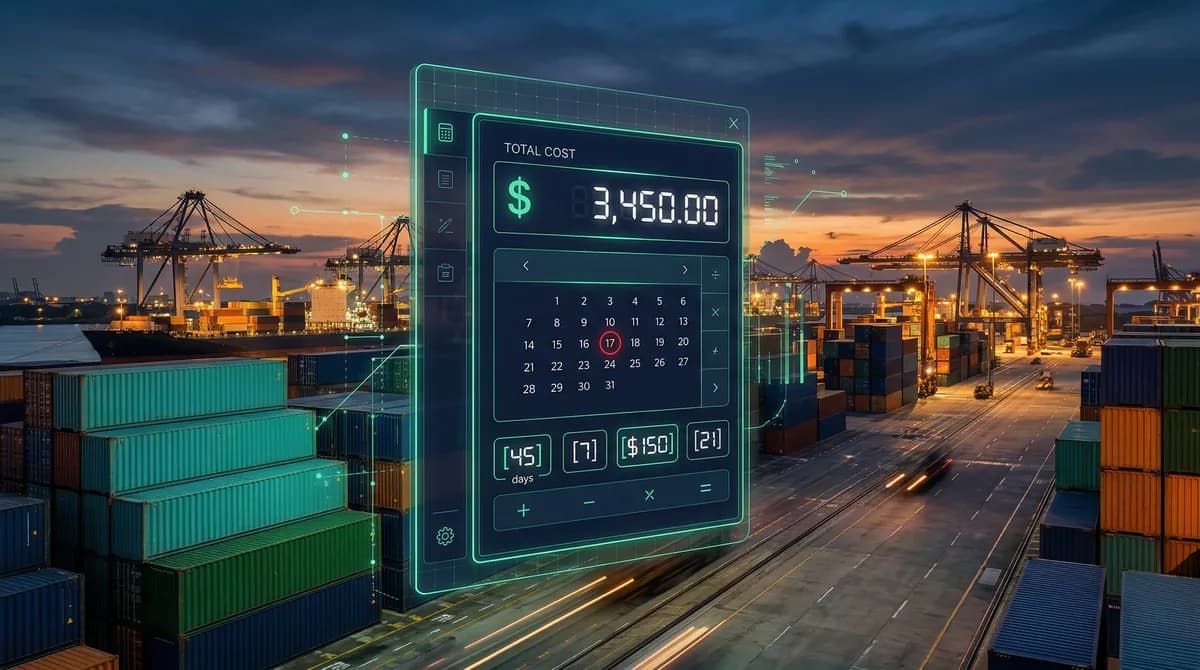
Enter your discharge date, the free days allowed under your carrier's tariff, the daily demurrage rate, and the number of containers. The calculator computes your LFD, shows how many days over free time you are today, and gives you the current total exposure.
For a spreadsheet-based version with tiered rate support, see our companion article How to Calculate Demurrage Charges Using LFD Data, which includes a downloadable Excel template.
How Demurrage Is Calculated
Demurrage charges follow a straightforward formula, but two variables — the free day count method and the rate tier — create most of the confusion in practice.
The Core Formula
Total Demurrage = Days Over LFD × Daily Rate × Number of Containers
Breaking that down step by step:
- Establish the discharge date. This is the date the vessel unloads your container onto the terminal — not the vessel arrival date, and not the container availability date. Carriers typically define this as the date recorded by the terminal system.
- Identify your free days. Check your Bill of Lading or your carrier's tariff. Standard tariff free days for major carriers range from 4–7 days for dry imports. Contract terms may give you more.
- Calculate LFD. Add the free days to the discharge date. A container discharged March 10 with 4 free days has an LFD of March 14. The LFD is the last day you can pick up at no charge.
- Count days over LFD. From March 15 onward, demurrage accrues. If today is March 18, that's 4 charged days.
- Apply the daily rate. Multiply charged days by the carrier's tariff rate. Most carriers use tiered rates that escalate after days 4–8 over LFD.
- Multiply by container count. Demurrage applies per container, per day. Ten containers four days late is 40 container-days of charges.
Tiered Rate Structures
The flat-rate calculator above gives you a baseline number. In reality, every major carrier uses tiered pricing that escalates the longer a container sits. Here is a worked example using Maersk's published tariff at the Port of Los Angeles:
| Period | Days Over LFD | Rate per Container | 5-Container Cost |
|---|---|---|---|
| Tier 1 | Days 1–4 | $225/day | $4,500 (4 days × 5 containers) |
| Tier 2 | Days 5–8 | $350/day | $7,000 (4 days × 5 containers) |
| Tier 3 | Day 9+ | $450/day | $2,250/day ongoing |
| Total at Day 10 | 10 days over | — | $13,750 |
A shipment that reaches Tier 3 is accruing charges at double the Tier 1 rate. The escalating structure exists to pressure prompt pickup — which is also why FMC regulations require that demurrage function as an incentive, not a revenue source. For the LFD fundamentals underlying all of this, see our complete LFD definition and explanation.
Calendar Days vs. Business Days
Most major carriers — Maersk, MSC, CMA CGM, ONE — count calendar days, including weekends and holidays. A container discharged on Thursday with 4 free days has an LFD of Monday. If you assumed business days, you would have calculated an LFD of Wednesday and missed it by two days.
A small number of carriers and terminals exclude Sundays, or exclude both Saturday and Sunday, from the free day count. Always verify with your specific carrier's tariff. The Federal Maritime Commission requires this information to be clearly stated in published tariffs.
Demurrage Rates by Carrier
The following rates reflect standard import tariff rates for dry 20' and 40' containers at major US ports, effective Q1 2026. Contract rates negotiated in service agreements are typically lower. Reefer containers carry higher rates. Always verify against your carrier's current tariff.
| Carrier | Import Free Days (Dry) | Tier 1 (Days 1–4) | Tier 2 (Days 5–8) | Tier 3 (Day 9+) | Reefer Surcharge |
|---|---|---|---|---|---|
| Maersk | 4 days | $225/day | $350/day | $450/day | +$75–$100/day |
| MSC | 5 days | $200/day | $325/day | $425/day | +$75/day |
| CMA CGM | 4 days | $250/day | $375/day | $475/day | +$100/day |
| Hapag-Lloyd | 5 days | $200/day | $300/day | $400/day | +$80/day |
| ONE (Ocean Network Express) | 5 days | $195/day | $295/day | $395/day | +$75/day |
| ZIM | 4 days | $225/day | $350/day | $425/day | +$75/day |
| Evergreen | 5 days | $190/day | $290/day | $390/day | +$70/day |
| COSCO | 5 days | $185/day | $285/day | $385/day | +$65/day |
Source: Individual carrier D&D tariff publications as of Q1 2026 (e.g., per Maersk's January 2026 D&D tariff update, CMA CGM's March 2026 tariff circular, Hapag-Lloyd's Q1 2026 D&D schedule). Rates are for standard import dry containers at US Pacific and East Coast ports. Contract rates and port-specific exceptions apply.
CMA CGM carries the highest Tier 1 rate at $250/day, while COSCO and Evergreen are generally the most forgiving at $185–$190/day. However, free day allowances matter as much as the daily rate. Maersk's 4-day standard allowance means demurrage starts a day earlier than MSC or Hapag-Lloyd at the same port. For a full carrier breakdown with additional data points, see our LFD tracking guide.
Demurrage and Storage Rates by Port
Terminal storage charges are separate from carrier demurrage and run on an independent clock. Both can apply simultaneously. The following table covers typical terminal storage rates at the five busiest US import gateways. Terminal operators publish these rates in their tariffs — contact the specific terminal for the most current figures.
| Port | Key Terminals | Free Days (Dry) | Storage Days 1–3 | Storage Days 4–6 | Storage Day 7+ |
|---|---|---|---|---|---|
| Los Angeles | APM, Fenix Marine, TraPac, WBCT | 4–5 days | $75–$100/day | $125–$150/day | $175–$198/day |
| Long Beach | LBCT, SSA Marine, ITS, PCT | 4–5 days | $75–$100/day | $125–$150/day | $175–$198/day |
| New York / New Jersey | APM Maher, PNCT, GCT Bayonne | 4–5 days | $100–$130/day | $150–$200/day | $200–$250/day |
| Savannah | Garden City Terminal (GPA) | 4 days | $75–$90/day | $100–$125/day | $125–$150/day |
| Houston | Bayport, Barbours Cut (Port of Houston) | 4–5 days | $60–$80/day | $90–$115/day | $125–$150/day |
NY/NJ terminals carry the highest storage rates — up to $250/day in the later tiers — reflecting the premium cost of operating in the New York market. Gulf ports like Houston are generally the most cost-effective for extended storage, though drayage costs in those markets can offset the savings. For a broader cross-port comparison, see US Port Free Days Comparison.
When carrier demurrage and terminal storage overlap — which happens on most containers that miss LFD — the combined daily exposure can reach $400–$500 per container at the Port of LA or NY/NJ. Ten containers ten days late at a West Coast port can easily produce a $40,000+ combined invoice.
Tips to Avoid Demurrage Charges
Most demurrage charges are avoidable. The following practices, applied consistently, will cut your exposure significantly.
1. Pre-Arrange Drayage Before the Vessel Arrives
Book your drayage carrier 48–72 hours before the estimated vessel arrival. Waiting until the container is available and then scrambling for a truck is the single largest source of missed LFDs. In port congestion periods, available trucks are allocated within hours of vessel arrival. See how seasonal congestion affects LFD risk in our guide on what is Last Free Day.
2. File Customs Entry Before Discharge
CBP entry processing takes 24–48 hours under normal conditions. If your customs broker files after discharge, you may lose 1–2 free days to the paperwork queue. Pre-filing entry on the vessel's AMS data before arrival eliminates this problem entirely.
3. Track All Three LFDs Simultaneously
Carrier LFD, terminal LFD, and rail LFD are independent. The terminal often sets a shorter free day window than the carrier. A container with a carrier LFD of March 15 and a terminal LFD of March 12 will start generating terminal storage charges on March 13, regardless of what the carrier portal shows. For a full breakdown of the differences, see our complete LFD tracking guide.
4. Request Extensions Before LFD Expires
If you know a delay is coming — customs exam, warehouse scheduling conflict, customer deferral — request an LFD extension from the carrier immediately. Most carriers will grant 2–4 extra days for documented reasons. Retroactive extensions after LFD has expired are rarely approved.
5. Dispute Charges on Inaccessible Containers
Under OSRA 2022 and the FMC's 46 CFR Part 545 final rule, carriers cannot legally charge demurrage for days when a container was unavailable for pickup due to terminal gate closures, carrier holds, or government inspections. Document every hold and gate closure. File disputes within the carrier's stated dispute window — typically 30–60 days from invoice date.
6. Negotiate Free Days in Your Service Contract
Standard tariff free days (4–5) are a starting point, not a ceiling. Importers moving 500+ TEUs per month regularly negotiate 7–10 free days. Even 2 additional days across 100 containers per month is equivalent to eliminating 200 potential demurrage days annually.
7. Automate LFD Monitoring
Manual portal checking across 8 carrier systems and 15 terminal websites doesn't scale and introduces human error. API-based LFD aggregation tools pull current LFD data across all carriers and terminals into a single dashboard, with configurable alerts at 48-hour and 24-hour thresholds.